

When AngularJS was released in 2010, it changed the way many organisations built web applications. It introduced a framework that made it easier to develop dynamic, single-page applications at a time when these were becoming increasingly popular. Since then, Angular has continued to evolve with regular releases and long-term support. Many organisations still rely on AngularJS, but using an unsupported front end creates security, compatibility and maintenance risks, even if the back end remains secure and well maintained.
Angular 2 was announced in 2014 and released in 2016. It introduced a completely different architecture, with TypeScript replacing JavaScript as the primary language. Existing AngularJS applications could not simply be upgraded. In most cases, they had to be rewritten, which made the transition controversial. Even so, AngularJS was widely used and supported for several more years before official support ended at the end of 2021.
Angular has continued to develop since then and is now available in the latest supported releases, including Angular V22. To distinguish it from AngularJS, it is now referred to simply as Angular. Although AngularJS has reached the end of its supported life, a surprisingly large number of organisations still depend on it for business-critical applications.
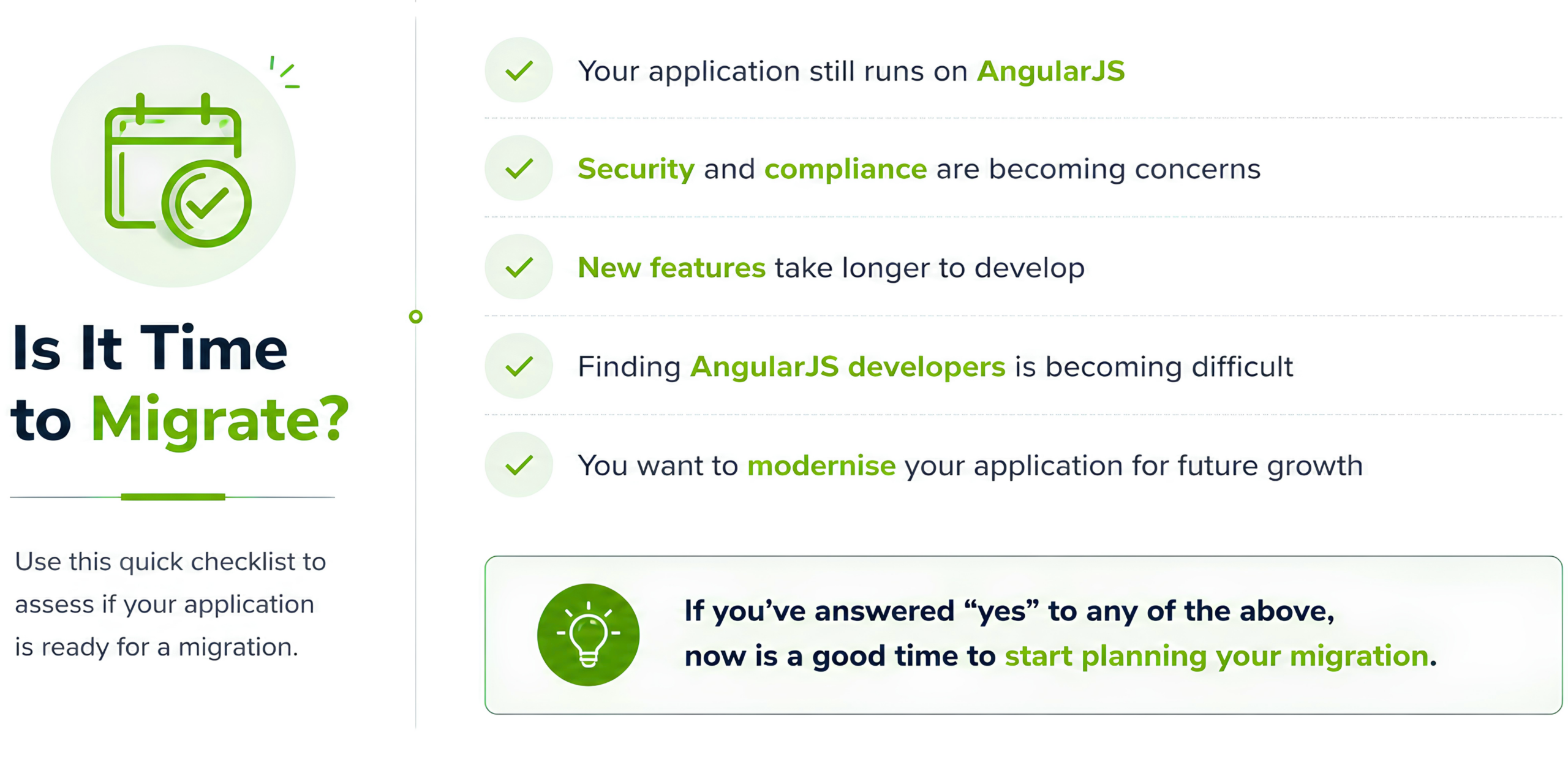
Moving away from AngularJS is about more than adopting a newer framework. It reduces security and compatibility risks and makes it easier to maintain and develop applications. It also provides access to performance improvements, tooling, and long-term support. Below are some of the main reasons organisations choose to migrate.
Improved performance and speed
Performance is one of the biggest differences between AngularJS and modern Angular. The framework was redesigned with performance in mind. Templates are compiled before the application runs, reducing the amount of work the browser has to do when loading a page. In practice, this leads to faster loading times, quicker rendering and a more responsive user experience.
Modern architecture and reusable components
Modern Angular takes a different approach to application structure. AngularJS applications often grew into large codebases where different parts of the application became closely connected. Angular uses a component-based architecture, making it easier to develop, test and maintain individual parts of an application without affecting the rest of the system.
This approach is particularly valuable for larger applications where multiple developers work on different features simultaneously. It also encourages code reuse, making future enhancements and maintenance simpler.
Improved security
Security has improved significantly in modern Angular. Built-in features such as Dom Sanitizer help prevent unsafe content from being injected into web pages, while support for Content Security Policy (CSP) allows organisations to control which scripts and resources browsers can load.
These features help reduce the risk of attacks such as cross-site scripting (XSS). They are not a substitute for secure development practices, but they provide a stronger foundation than AngularJS.
Active support and regular updates
One of the main advantages of Angular is that it continues to receive regular updates, security patches and new features. AngularJS reached the end of official support at the end of 2021, so the Angular team no longer addresses security issues or bugs.
For organisations still running AngularJS applications, this increases the risk of compatibility issues with modern browsers and third-party libraries. Over time, maintenance also becomes more difficult as developers, tools and libraries move on.
Migrating to Angular means your application continues to receive security updates, browser compatibility improvements and access to new framework features. Keeping Angular and its dependencies up to date also makes future upgrades much easier.
Continuing to run AngularJS can also increase the risk of security vulnerabilities and make it harder to meet regulatory requirements such as GDPR, NIS2 and DORA.
Easier development and maintenance
Modern Angular provides a better development experience than AngularJS. TypeScript introduces static type checking, making it easier to identify errors during development rather than after deployment. Better editor support, code navigation and refactoring tools also improve developer productivity.
Angular CLI (Command Line Interface) simplifies many everyday development tasks, including creating projects, generating components, building applications and running tests. These tools reduce repetitive work, improve consistency and help teams deliver software more efficiently.
How to plan an AngularJS migration
Migrating from AngularJS does not have to be an all-or-nothing exercise. With careful planning, the work can be completed in stages, reducing both risk and disruption to day-to-day business.
Before starting a migration, it is worth taking the time to:
For many organisations, a phased migration is the most practical approach. Individual modules can be modernised one at a time while the existing application continues to operate. This reduces operational risk, simplifies testing and allows users to adapt gradually as new functionality is introduced.
Which framework should you migrate to?
If your application is built with AngularJS, Angular is often the simplest choice. Although it is a different framework, it is developed by the same team and continues to receive regular releases and security updates.
There are situations where another framework may be a better fit. Applications with different technical requirements or business goals may be better suited to React or Vue. The right choice depends on factors such as the application’s architecture, future development plans, the skills available within your team and how the application is expected to evolve.
Rather than recommending the same solution for every project, we assess each application individually before recommending the framework that best supports your business and long-term objectives.
If your AngularJS migration is part of a wider application modernisation programme, you may also be interested in our software migration services.
Summary
Migrating from AngularJS to Angular is about more than replacing one framework with another. It is an opportunity to improve security, performance, and maintainability while reducing the risks associated with unsupported software. As browsers, operating systems and third-party libraries continue to evolve, keeping an AngularJS application running becomes increasingly difficult.
Every AngularJS application is different. Some can be modernised in stages, allowing existing functionality to remain in place while individual modules are updated. Others are so closely tied to the original framework that a complete redevelopment is the better option. The right approach depends on the application’s architecture, dependencies, business requirements and plans for future development.
We begin by assessing the application before recommending a migration strategy. This includes reviewing the codebase, identifying technical risks, evaluating third-party dependencies and deciding whether a phased migration or a complete rewrite is the better choice. The aim is to minimise disruption while giving you an application that is easier to maintain and develop.
Once the migration is complete, Angular should be kept up to date through regular framework and dependency updates. Smaller, incremental upgrades are easier to manage than leaving the application unchanged for several years and then facing another major migration.
Ready to plan your migration?
If you’re considering moving away from AngularJS, the first step is understanding the application you already have. We can review your existing system, discuss the available options and recommend a migration approach that fits your business, budget and timescales.
Whether you’re planning a phased migration or replacing the application completely, we can help you reduce risk and plan the work in a way that suits your organisation.
Related Articles
- Angular 18 Improvements – Discover the performance, developer experience and framework enhancements introduced in Angular 18.
- Why Angular 19 is a Game Changer – Learn about the latest features and improvements available in Angular 19.
Contact us to discuss your AngularJS application and the options available.
When was AngularJS released and when did support end?
AngularJS was released in 2010 and quickly became a popular way to build dynamic, single-page applications. It continued to be widely used and supported for several years after Angular 2 arrived, but official AngularJS support ended at the end of 2021.
What is the recommended strategy for executing an AngularJS update?
The safest strategy is an incremental, staged migration rather than a complete rewrite all at once. By updating and deploying one component or module at a time, developers can easily isolate, identify, and fix issues while continuously testing the application to ensure system stability.
How should third-party dependencies be handled during an AngularJS update?
You must thoroughly inventory all dependencies and third-party libraries currently used by the application before touching the core code. Because many older libraries are incompatible with modern frameworks, you must identify replacements or version updates for these libraries to ensure full compatibility.
What changed when Angular 2 was released?
Angular 2, announced in 2014 and released in 2016, introduced a completely different architecture built on TypeScript instead of JavaScript. Existing AngularJS applications could not be upgraded directly and in most cases had to be rewritten, which made the transition controversial at the time.
Why is running an unsupported AngularJS application risky?
Since official support ended, the Angular team no longer fixes bugs or patches security issues in AngularJS. This raises the risk of compatibility problems with modern browsers and third-party libraries, and can make it harder to meet regulatory requirements such as GDPR, NIS2 and DORA.
How does modern Angular improve application performance?
Modern Angular compiles templates before the application runs, reducing the work the browser has to do when loading a page. This results in faster loading times, quicker rendering and a more responsive user experience compared with AngularJS.
What is the benefit of Angular’s component-based architecture?
Unlike AngularJS applications, which often grew into large, tightly coupled codebases, modern Angular uses a component-based architecture. This makes it easier to develop, test and maintain individual parts of an application, supports multiple developers working in parallel, and encourages code reuse.
What security features does modern Angular offer?
Modern Angular includes built-in security features such as DomSanitizer, which helps prevent unsafe content injection, and support for Content Security Policy (CSP), which controls which scripts and resources browsers can load. Together these help reduce the risk of attacks such as cross-site scripting (XSS).
Does migrating to Angular give ongoing support and updates?
Yes. Angular continues to receive regular updates, security patches and new features, unlike AngularJS which reached end of official support at the end of 2021. Keeping Angular and its dependencies up to date also makes future upgrades easier.
How does TypeScript improve the development experience?
TypeScript introduces static type checking, making it easier to catch errors during development rather than after deployment. It also improves editor support, code navigation and refactoring, which boosts developer productivity compared with plain JavaScript used in AngularJS.
What is the Angular CLI and why does it matter?
The Angular CLI (Command Line Interface) simplifies everyday development tasks such as creating projects, generating components, building applications and running tests. It reduces repetitive work, improves consistency and helps teams deliver software more efficiently.
Can an AngularJS migration be done in phases?
Yes, migrating from AngularJS does not have to be an all-or-nothing project. With careful planning, individual modules can be modernised one at a time while the existing application keeps running, which reduces operational risk and lets users adapt gradually.
Should every AngularJS application migrate to Angular, or could another framework be better?
Angular is often the simplest choice since it is developed by the same team and continues to receive regular releases and security updates. However, applications with different technical requirements or business goals may be better suited to alternatives such as React or Vue, depending on architecture, future plans and team skills.
What should be done before starting an AngularJS migration?
Before migrating, it helps to create a full backup of the application and database, review third-party libraries for unsupported packages, decide between a phased or single-project migration, test thoroughly after each stage, and document all changes for future maintenance.