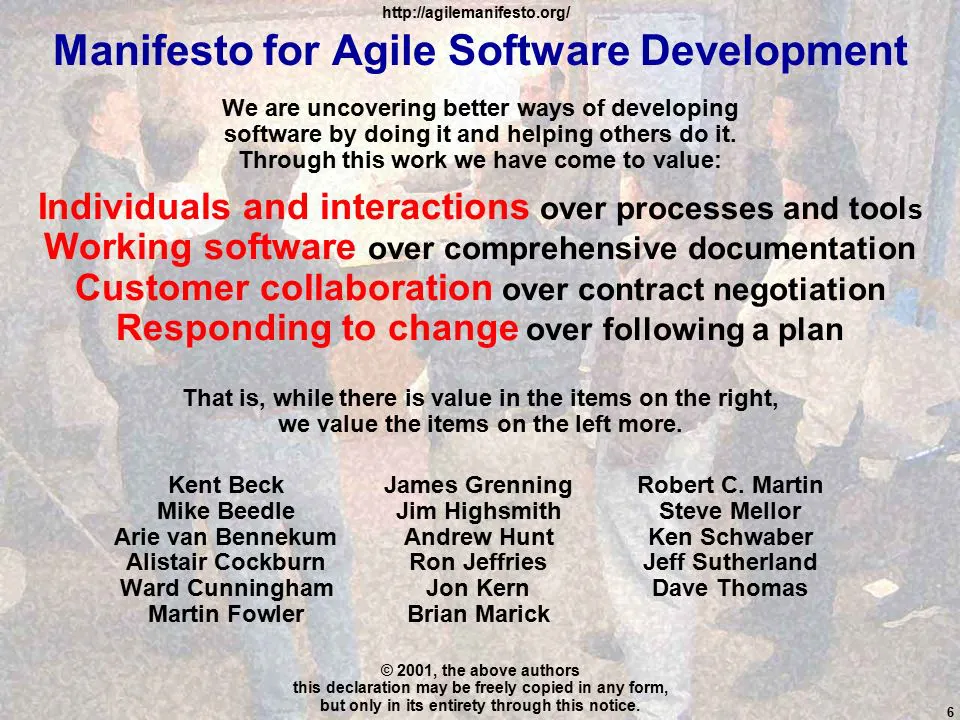

Once upon a time, seventeen software visionaries gathered at a lodge at Snowbird ski resort in Utah to challenge the status quo of software development. These pioneers, including Alistair Cockburn, Ward Cunningham, Martin Fowler, and Ken Schwaber, had one goal: to revolutionise software development by embracing change and collaboration. Little did they know, they would create a movement that would change the course of software development history forever. The Agile Manifesto was born on February 11-13, 2001!
The Agile Movement
At present, more than two decades later, the Agile movement has spread like wildfire, becoming the go-to approach for many software development projects worldwide. But is it still living up to its original promise? Or has the spark that the pioneers ignited started to fade? In this article, we will examine the origins of the Agile Manifesto, explore its impact on the software industry, discuss the current state of the agile movement, and potential future challenges.
The Agile Manifesto laid the foundation for a more flexible, iterative, and collaborative approach to software development, emphasising the importance of individuals and interactions, working solutions, customer collaboration, and responsiveness to change.
Over the years, the movement has evolved, giving rise to different Agile methodologies such as Scrum, Kanban, and DevOps. These methodologies have helped countless organisations deliver value to their clients’ businesses, including at Gislen Software, where we have tried to adapt which has adapted Agile principles to overcome challenges of software outsourcing, time zone differences, and cultural differences.
Challenges and concerns
But not everything is rosy in the world of Agile. As the movement gained popularity, some of its founding principles have been overshadowed by a focus on methodologies, leading to concerns about Agile’s effectiveness. One of the Agile Manifesto’s original authors, Andrew Hunt, even went so far as to label the movement a failure, arguing that Agile practices have strayed from their intended path and become more about following rules than truly embracing change and collaboration.
Many practitioners focus more on methodologies than on understanding the real values of the Agile Manifesto. “Agile” has also been accused of losing its meaning and becoming another marketing buzzword. Despite this, it can still deliver successful software projects when applied correctly.
State of Agile
Agile continues to evolve and adapt to the changes of the software industry, as demonstrated by the 16th annual State of Agile report. As Agile extends beyond software development into other industries, organisations increasingly focus on aligning Agile practices with their business objectives. High-performing Agile teams prioritise people-centric values, culture, tools, and leadership empowerment.
However, challenges persist. A lack of leadership understanding, resistance from business teams, and clashes with company culture have hindered the adoption of Agile practices. In addition, the increasing prevalence of remote and hybrid workforce has led to the adoption of new tools and technologies, such as virtual digital whiteboards, further highlighting the need for Agile to continue developing.
So, is the agile movement still true to its original values, or has it become a shadow of its former self? It is not an easy question to answer since the answer may lie somewhere in between. Agile has undoubtedly grown and evolved over the years, perhaps straying from some of its founding principles, but it definitely remains a powerful approach to software development, at least when used correctly. For companies like Gislen Software, understanding and applying the core values of the Agile Manifesto while continually adjusting to changing circumstances is the key to unlocking the full potential of Agile software development.
Gislen Software: Agile in Action
To appreciate the agile methods, it helps to watch them at work. In our company, we are using Scrum, Kanban, and DevOps, to manage the realities of outsourcing, differing time zones, and the subtleties of working across cultures. By adjusting our routines when needed and keeping communication clear and frequent, we have delivered reliable software to clients across Europe. Our collaboration with Epical Group, has even allowed us to form blended teams that operate smoothly despite distance, proving that well-run Agile practice can bridge both geography and working style.
Addressing Agile Challenges: Embracing Continuous Improvement
Agile has its difficulties, as Andrew Hunt and others have pointed out. Meeting these requires a habit of honest review and steady refinement, so that day-to-day practice remains close to the spirit of the Manifesto. When organisations pay attention to clear communication, thoughtful collaboration, and a willingness to adjust course, the methods tend to work as intended. In doing so, they are more likely to keep delivering real value and to support genuine innovation rather than activity for its own sake.
Future-Proofing Agile: Strategies for Success
As the software development landscape evolves, Agile methodologies must adapt to remain effective. Organisations should invest in ongoing education and training for their teams to future-proof the practices, ensuring everyone understands the Agile Manifesto’s values and principles. Fostering a culture of experimentation and learning can help organisations uncover new ways to apply the methodologies and maintain their competitive edge in the ever-changing software industry.
Back to the origin
As we trace the story back to the Utah mountains where the Manifesto first took shape, it is natural to ask how the movement will fare in the years ahead. Its future will not hinge on slogans or ceremony, but on the judgment of those who use it. If practitioners stick to the underlying values and adjust their methods with care, Agile is likely to remain a steady guide in a field that changes without pause.
When we reflect on the story of the Agile Manifesto and its impact on software development, we can learn valuable lessons about the importance of adaptability, collaboration, and staying true to our principles. Agile has the potential to continue making a difference in the software industry, but only if its practitioners remain dedicated to fostering a culture of innovation, customer-centricity, and continuous improvement.
Staying true to the values of the Agile Manifesto
For companies such as ours, the work does not finish with a certificate or a well-run project. The task is to keep the principles of the Manifesto at the centre of everyday practice and to adjust methods to suit real situations rather than the other way round. When we do that, we tend to serve clients better and make room for thoughtful, durable engineering.
The wider movement faces both promise and strain. Its ideas have matured, yet they still need careful interpretation if they are to keep pace with the pace and complexity of modern work. Agile will continue to shift as new tools, expectations, and pressures emerge, but its core spirit remains steady. It began with a small group in the Utah mountains and has since travelled far, not because of grand slogans but because its values proved useful. That quiet resilience is likely to guide software development for many years.
Contact us to get to know more about how to develop using agile methodologies